| Universe | Omi |
| System | Galus |
| Planet | Cetus |
| Nations | Suko |
| Languages | Ictuk |
Vemachia sapiens ("smart wasp warrior"), V. sapiens, or Vemas are a species of humanoid wasps who share similar DNA to the warrior wasps found on Earth.
Vemas can grow anywhere from 1.8-2.4 m at 90-136 kg, with queens growing up to 3 m at 210 kg in some cases. Aside from queens, Vemas appear fairly androgynous.
A Vema's head is shaped like an almond, with the top of the almond starting at the mandibles. Queens have naturally thicker, bonier heads. For reference, here is a picture of a Synoeca septentrionalis, who share a similarly shaped head:
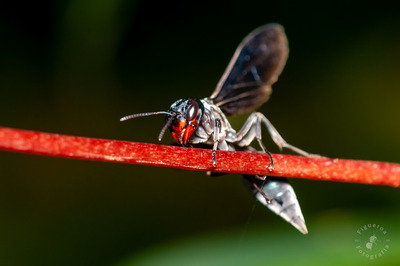
Vemas have 2 antennae that extend out from the top-front-center of the head. They each have 3 segments, the inner-most segment being red and the other 2 black. In males and females, these antennae are about 30 cm long and 2 cm thick. However, in queens, they are about 50 cm long and 4 cm thick.
Vemas have 2 black iridescent eyes spaced about 65 mm apart from the center. They are angled at around 35 degrees.
Vemas have a set of mandibles that extend out from where their cheeks would be. Male mandibles measure 12 cm from the base, females 8 cm, and queens 15 cm. These mandibles have some independent freedom from each other, though it proves neurogically difficult for most Vemas.
Vemas have a retracted proboscis that can be stuck out slightly above the mandibles. The muscle used to extend the proboscis naturally has some fine tuning as a Vema matures. There is also a smaller muscle along it that allows for squeezing of the proboscis.
Vemas have 2 upper arms attached to their shoulders, each of which are around 0.9-1.2 m for males and females, or around 1.5 m for queens.
Vemas have 2 thick wings attached to their shoulder blades. They are riddled in thick red veins and are fairly opaque. These wings grow all the way down to the feet at about 1.3-1.9 m, though queens' wings disintegrate upon feeding fresh larvae due to nutrient transfer.
Vemas have 2 lower arms around their midsection. They are shorter and less bulky than the upper arms, at about 0.6-0.8 m, and 1 m for queens.
Vema hands have 2 small pincers with about 15 degrees of freedom in the wrists.
Vema pelvises are thick and wide, about 15% wider than the abdomen, in order to support the upper body and especially the wing muscles and lower arms.
Vema legs are short but thick in the femur section and long in the tibia and foot section. The tibia contains raised ridges as added structural support.
Vemas have eagle-like feet with bent toes and a bigger back toe that extends from the "palm" of the foot for absorbing landings and launching more easily. They have short, sharp talons designed for gripping onto surfaces.
More sounds will be added as research progresses.
| Mandibular | Mandi-proboscial | Proboscial | Thoraxal | Pharyngeal | ||||||||
| Plosive | t | d | g | k | ʔ | |||||||
| Nasal | m | |||||||||||
| Trill | r | |||||||||||
| Tap or Flap | ||||||||||||
| Fricative | f | v | ɸ | β | s | ɹ | ʃ | ʒ | h | ɦ | ||
| Lateral fricative | ||||||||||||
| Approximant | ʋ | j | ||||||||||
| Lateral Approximant | ||||||||||||
| Front | Central | Back | ||
| Close | y | ʉ | u | |
| ʏ | ʊ | |||
| Close-Mid | ø | ɵ | o | |
| Open-Mid | œ | ɞ | ɔ | |
| Open | ɶ | ɒ |
Vemas have 2 pheromones used for reproduction: Benzylacetone and 2,5-Dimethylpyrazine. During arousal or courtship, Vemas' bodies heat up and secrete the respective liquid which then evaporates off their skin, produces a sweet or savory smell. 2,5-Dimethylpyrazine is released mainly to attract mates, but both sexes can emit it. On arousal or during sex, Benzylacetone is released, heightening the nerves in Vemas' skin, especially for touch, pressure, and vibration.
Male Vemas have retractable penises which have increasing nerve endings as they get closer to the base. The phallus root begins 3 inches within an Ictuza, attaching to the ischial bone in the pelvis. Above the root is a small semenal resevoir with a muscle that sequentially squeezes from the top of the resevoir to the start of the phallus body. The phallus body extends out on average 24-26 cm, with the lower end being 20 cm and the higher end being 30-33 cm. The phallus body is a bulbous cone with the thinnest area being around 6 cm and the thickest area (near the center) around 8 cm thick. The body also has depressed rings along the length of the body, about every 5 cm. The tip of the penis is conical until it tapers into a pointier appearance at the top.
Female Vemas' vaginas are 2 holes encapsulated by a labia. The upper hole leads to a canal of about 27-30 cm deep, which has ridges every 2-5 cm that contain denser sections of nerve endings. The lower hole is a tube connected to a resevoir for eggs. Surrounding the tube is a muscle that sequentially squeezes from the top of the resevoir to the end of the tube, releasing any eggs inside. Seperating the resevoir and the canal is a membrane that forms the initial eggs, which take about a week to form. The eggs can be released at any time, and upon release a liquid that, when mixed with sperm, acts as an activator for the eggs to begin growing outside the body.
In the age of modern medicine, Vemas can live to around 110 years old, but they get much slower around age 80 from stiff muscles and thickened skin.