| Universe | Omi |
| Planets | Cetus |
Galus is a binary system composed of the red supergiant Galus A and the white dwarf Galus B. Its goldilocks zone ranges between 1,119 AU - 2,090 AU, due to both stars having a molten layer of triclinic crystals which arcanons circulate through to multiply their apparent luminosity by an average of 8.7 times.
Galus A is an M5 red supergiant with a radius of 211 R⊙,
a base luminosity of 415,237 L☉,
an apparent luminosity of 3,612,562 L☉,
a mass of 9.6 M☉,
and a temperature of 3,315 K.
Due to its high luminosity, Galus A is the only star that can actually be seen from the planets.
Galus B is a D-Type white dwarf with a radius of 0.01 R⊙, a base luminosity of 0.034 L☉, a a mass of 1.32 M☉, and a temperature of 24,785 K.
| Universe | Omi |
| Nations | Suko |
| Species | Vemachia Sapiens |
| Languages | Ictuk |
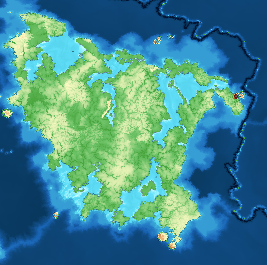
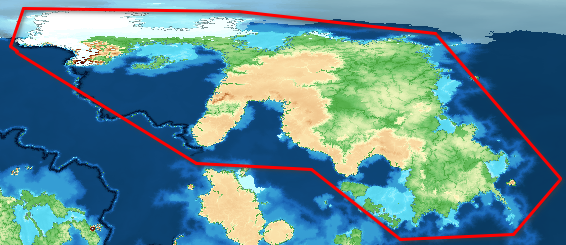
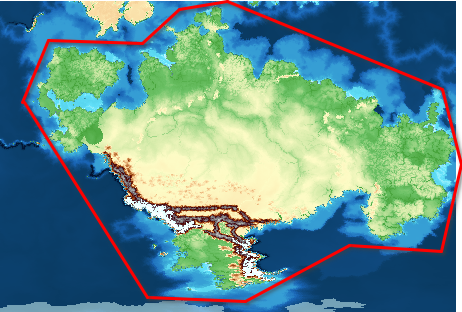
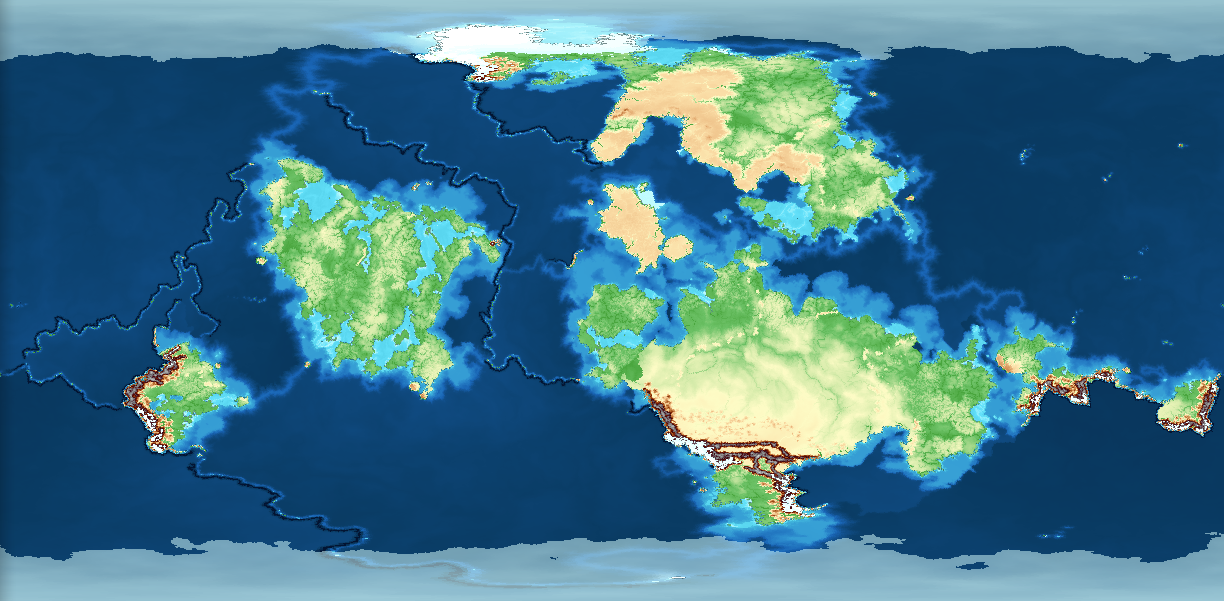
Cetus is a habitable planet that resides around 1,300 AU from Galus. It has a radius of 1.6 R🜨, a mass of 0.27 M🜨, a rotational speed of 1,246 km/h along the equator, and an axial tilt of about 11 degrees, and a revolution speed of 25,292 m/s, which makes its tropical year about 34,000 Earth years.
Due to its mass, it would make mathematical sense for Cetus to have a low gravitational acceleration: about 2.6 m/s² (about 27% of Earth's gravity). However, during the early stages of its creation, strong solar falres bombared the planet, causing not only heat to generate crystals, but charging those crystals as well. There is a Crystalsphere beneath the planets Lithosphere, which is rich in hexagonal-latticed crystals that can increase the gravity anywhere from 4 to 12 m/s².
Cetus has 2 moons, Lus and Lao, that closely orbity each other, while their barycenter very eccentrically orbits Cetus. Lus is gray with glowing blue cracks. It's the smaller of the 2 moons, with a radius of about 0.02 R🜨. It's hypothesized that a large asteroid packed with arcanon-charged crystals impacted Lus very long ago, causing craters and cracks to atomically shift into plutonium, causing a soft blue glow that can be seen from Cetus during the night. Lao is off-yellow due to its high concentration of sulfur. It has an average radius of 0.035 R🜨 and it is oblong due to Lus orbiting around it.
Because of Cetus's extremely long revolution, seasons end up spanning thousands of generations of species. Many species only label 2 seasons--one for summer and one for winter-- that gradually transition from one another.
The Age of Evinus is characterized by its warmer temperatures and higher water levels, with Earth-like summers at its peak.
The Age of Venetrum is characterized by its cooler temperatures and lower water levels. Species can see significantly more ice and snowy weather, with Earth-like winters at its peak.
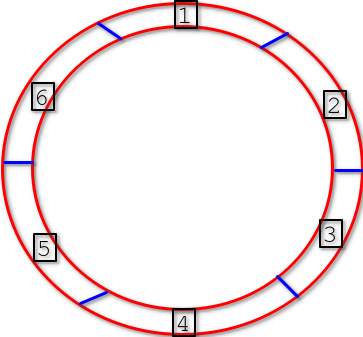
Cetus comes with several time systems from different cultures, so for easier math scientists created CDT, or Cetus Date/Time. The start of this timer is marked by the first recognized government body, which on Earth was around 12,000 BCE. The date is divided into 3 major sections: the era, which is the time it takes for Cetus to revolve around Galus once at 34k years, the age, which is a 12-segment subdivision of an era denoted by the rise and fall of the seasons at 2.83k years, and the sub era, which is 1/36,000th of an era at about 1 year.
FormatThe most common format used for CDT is "era,age,sub era". For example, CDT 1,2,512 denotes that 1 era (34k years), 2 ages (5.66k years), and 512 years have passed since the first government was formed, or about 40,172 years.
Current CDT YearThe current year is CDT 0,4,2594, or about 1914 CE on Earth.